


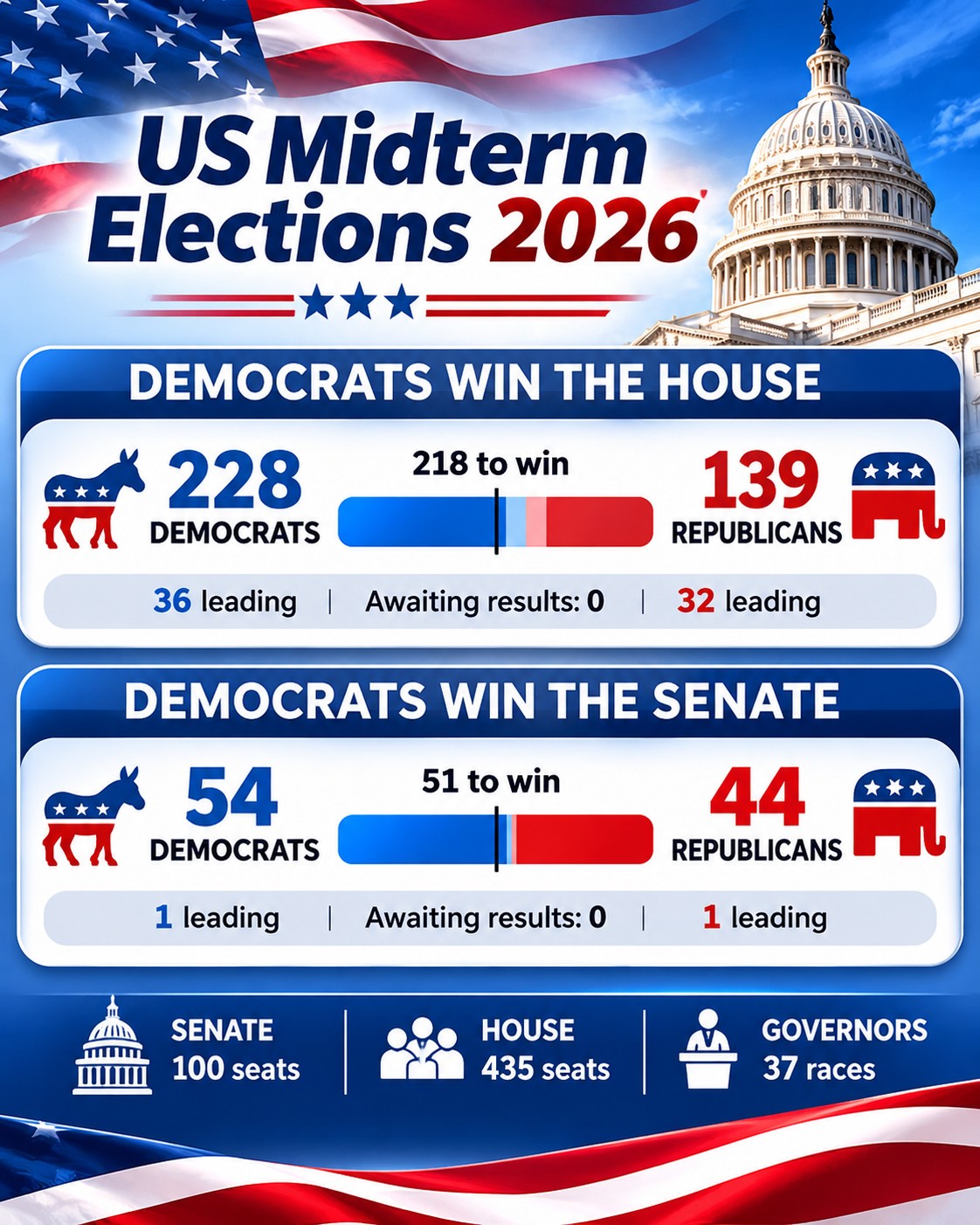
November 4, 2026 | United States
Democrats have won control of both chambers of the United States Congress in the November 3, 2026, midterm elections, marking a significant shift in Washington’s political balance and presenting new challenges for President Donald Trump during the remaining two years of his presidency.
According to reports from Reuters and the Associated Press, Democratic candidates secured victories in several states traditionally considered Republican strongholds, helping the party regain majorities in the House of Representatives and the Senate.
Although some electoral contests remain unresolved, projections indicate that Democrats have secured enough seats to control both chambers when the new Congress convenes in January 2027.
What Are the US Midterm Elections?
Congressional elections take place every two years in the United States. Elections held halfway through a president’s four-year term are known as midterm elections.
In 2026, voters elected representatives to all 435 voting seats in the House of Representatives and contested 35 of the Senate’s 100 seats.
Members of the House serve two-year terms, while senators serve six-year terms, with approximately one-third of Senate seats contested every two years.
The elections also included races for state governors and other state and local offices.
Why Does Democratic Control of Congress Matter?
Before the elections, Republicans controlled the White House, the House of Representatives and the Senate.

That arrangement gave President Trump the advantage of working with Republican majorities in Congress when pursuing his legislative priorities.
With Democrats now projected to control both chambers, the balance of power between the executive and legislative branches is expected to change substantially.
Democratic lawmakers will have greater authority to conduct congressional investigations, oversee federal agencies, review government spending and challenge legislation supported by the administration.
However, President Trump will retain his constitutional executive powers, including the authority to veto legislation passed by Congress.
The Economy and the Iran War Shape the Election
Economic concerns, the cost of living and the United States’ war with Iran featured prominently in the 2026 midterm elections.
According to Reuters, voter frustration over rising living costs and the administration’s handling of major domestic and international issues contributed to Democratic gains.
Democratic candidates focused on affordability, government accountability and criticism of the administration’s economic and foreign policies.
Republican candidates, meanwhile, defended the administration’s record on issues including national security and immigration while challenging Democratic policy proposals.
The results indicate a substantial change in congressional representation, although voters’ priorities and motivations varied across states and electoral districts.
House of Representatives vs Senate: What Is the Difference?
The United States Congress consists of two legislative chambers with distinct constitutional responsibilities.
The House of Representatives has 435 voting members, with seats distributed among states according to population. Representatives serve two-year terms.
The House has the constitutional authority to initiate revenue legislation and bring impeachment charges against federal officials.
The Senate consists of 100 members, with two senators representing each state regardless of population. Senators serve six-year terms.
The Senate has special responsibilities for confirming many presidential appointments, considering treaties and conducting impeachment trials.
Both chambers generally must approve the same legislation before it can be presented to the president for signature or veto.
Neither chamber has unrestricted authority over the other.
What Could the Results Mean for US Foreign Policy?
Democratic control of Congress could influence federal spending, foreign assistance, immigration legislation and oversight of the administration’s international decisions.
Congress can hold hearings, examine foreign policy decisions and determine funding for many government programmes.
These responsibilities could have implications for US engagement with Afghanistan, Iran and other countries.
However, the president retains substantial authority over diplomacy and the conduct of foreign relations.
A change in congressional control therefore does not automatically mean an immediate change in American policy towards Afghanistan or the wider region.
What Happens Next for President Trump?
President Trump, who returned to the White House following the 2024 presidential election, will face a Congress controlled by the opposing party during the final two years of his second term.
The new political balance could make it more difficult for the administration to pass major legislation without Democratic support.
It could also lead to increased congressional oversight and investigations of executive branch decisions.
At the same time, negotiations between the two parties may still produce agreements on selected domestic and international issues.
The 2026 midterm elections have reshaped the political landscape in Washington, setting the stage for a period of divided government that could influence American policy through the next presidential election in 2028.
Sources: Reuters, Associated Press and US election reporting, November 4, 2026.