

Afghanistan possesses vast natural resources, but an old and increasingly important question remains unanswered: how much do the people living on top of this wealth actually benefit from it?
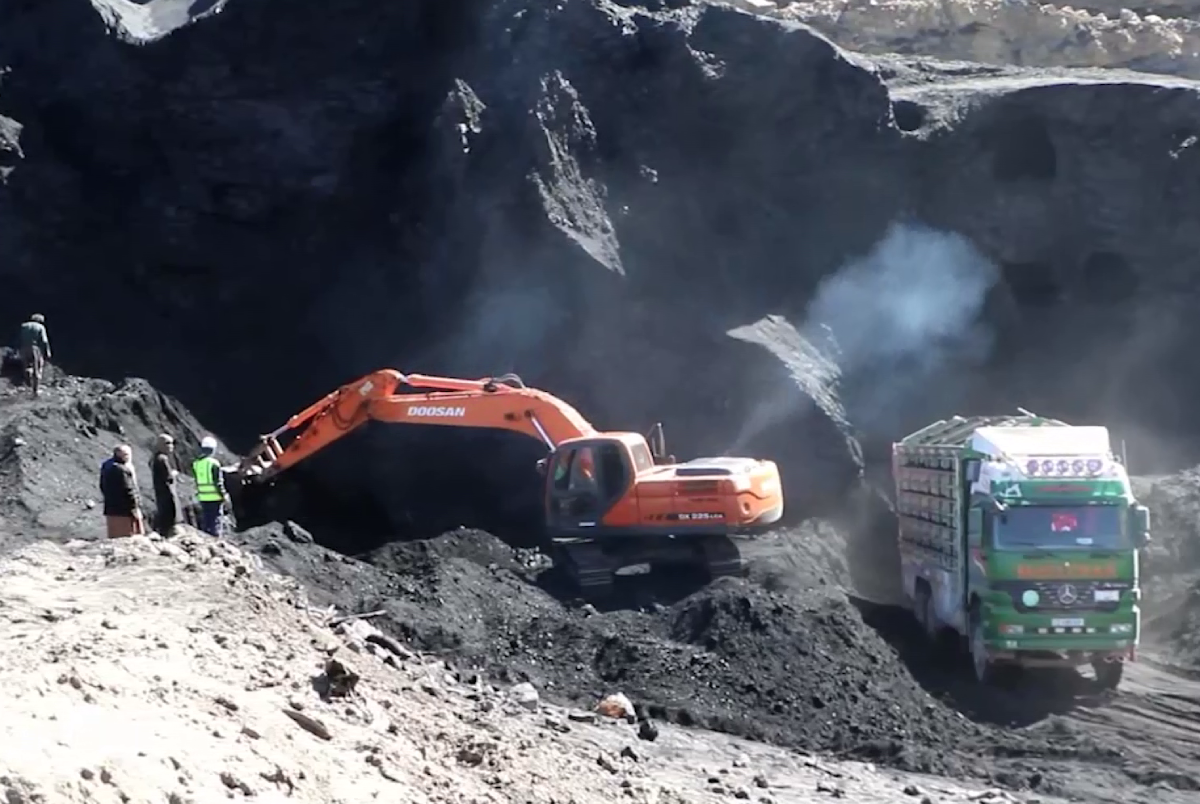
In Balkhab district of Sar-e Pol province, large-scale coal extraction has continued under the Taliban-controlled National Development Corporation. Officials have repeatedly described Balkhab’s coal as an important national asset and have promised professional extraction, employment and development.
Yet accounts from miners and local residents present another side of the story — one of difficult working conditions, delayed wages and continuing questions about where the revenues generated from Balkhab’s coal ultimately go.
Abdul Rahman Atash to the People of Balkhab: You Will See the Difference “in Practice”
During a visit to Balkhab, Abdul Rahman Atash, head of the National Development Corporation, told local people that the company’s approach to mining would be fundamentally different from practices of the past.
He argued that the objective should not simply be to remove the minerals and take them away, but to extract them according to proper mining standards so that what he described as the people’s “capital” would not be wasted.
He also promised that services should be provided to local communities before this wealth was taken out of the area.
Those words now raise an unavoidable question:
What happened to the promise of protecting “your capital”, and where is the share of the people of Balkhab in this wealth?
Miners Tell a Different Story
Footage filmed inside Balkhab’s coal-mining areas has provided a glimpse into the lives of workers who extract the coal from deep inside the mountains.
According to accounts given by some workers, wages have in some cases remained unpaid for months — and, according to their claims, even longer — despite repeated attempts to obtain payment.
These claims require scrutiny and a response from those responsible for managing the mines. But they also highlight the sharp contrast between official promises of development and the experiences described by workers on the ground.
The men doing this work spend their days extracting a resource described by officials themselves as the people’s wealth.
That creates a simple question: if the coal is the people’s capital, what tangible share of that capital reaches the people who live in Balkhab?
When Control of the Mines Changed
Before Balkhab’s coal mines were placed under the National Development Corporation and local communities lost control over much of the extraction and sale, some residents made their living directly from small-scale mining.
The income may have been limited, but much of it circulated within Balkhab’s economy.
A miner earned money and spent it in the local bazaar. Shopkeepers benefited. Farmers and livestock owners sold their products. In this way, at least part of the wealth generated by the mines remained within the community.
With extraction and sales brought under the control of the Taliban authorities, the role of many local people changed from local participants in the resource economy to workers within a centrally controlled system.
That change makes one question even more important:
What share do the people of Balkhab receive from the wealth being extracted from their own region?
Balkhab Coal and the Qosh Tepa Canal
The National Development Corporation has publicly stated that revenues generated from Balkhab’s coal are being used to finance major national projects, particularly the Qosh Tepa Canal.
A national infrastructure project can potentially benefit millions of people and contribute to Afghanistan’s long-term economy.
But national development and local justice should not have to contradict each other.
If resources from Balkhab are helping finance projects elsewhere in Afghanistan, residents of Balkhab are entitled to ask what proportion of that wealth is being reinvested in the district where the resource originates.
Roads, healthcare, schools, electricity, clean water, employment and economic infrastructure are not unreasonable expectations for a community producing valuable natural resources.
Roads for Coal, or Roads for People?
Officials have pointed to the construction of hundreds of kilometres of roads connecting mining areas as evidence of investment.
Such infrastructure is significant.
But another distinction matters: were these roads primarily constructed to improve the lives and economy of local communities, or primarily to make the extraction and transportation of coal more efficient?
Ideally, mining infrastructure should accomplish both.
A road built to carry coal should also connect villages, markets, schools and healthcare facilities. Otherwise, infrastructure risks becoming primarily a mechanism for taking wealth out rather than bringing development in.
Coal Will Not Last Forever
Coal is a non-renewable resource.
Every tonne removed from Balkhab permanently reduces a finite natural reserve.
The most important measure of successful resource management, therefore, is not simply how much coal can be extracted each day or each year.
The real measure will come later:
When the coal is gone, what will remain in Balkhab?
Will there be functioning roads, schools, healthcare facilities, electricity, businesses and sustainable employment?
Or will the mountains have lost their coal while the underlying economic problems of the district remain?
From Balkhab’s “Coal War” to Badakhshan’s “Gold War”
Recent developments in Badakhshan have also revived memories of what happened in Balkhab in 2022.
Mawlawi Mehdi, an ethnic Hazara Taliban commander, entered into armed confrontation with the Taliban leadership after disagreements in Balkhab.
Four years later, Taliban commander Juma Khan Fateh became involved in fighting with Taliban forces in Badakhshan.
Fateh eventually surrendered on 17 August 2026 after nearly a week of fighting. Local sources told media outlets that his surrender followed negotiations with Fasihuddin Fitrat, the Taliban army’s chief of staff.
Badakhshan is also one of Afghanistan’s resource-rich regions, particularly in gold and precious stones.
Control over such resources can carry more than economic significance. In fragile political environments, control over mines can also intersect with local influence, revenue and power.
Yet amid competition over valuable resources, one group can easily be pushed to the margins: the people who actually live there.
The same question raised in Balkhab therefore applies to Badakhshan:
What share do local communities receive from the resources beneath their land, and how much of the resulting revenue is reinvested in the development of their own region?
From this perspective, one might speak — with deliberately dark irony — of Balkhab’s “coal war” and Badakhshan’s “gold war”: two very different conflicts, but ones that raise a common question about resources, power and the place of local communities.
The terms should not be understood as claims that coal or gold alone caused either conflict. Afghanistan’s local conflicts involve political, military, ethnic and personal factors that cannot responsibly be reduced to a single explanation.
Security Without Political Choice?
Supporters of the Taliban frequently point to the significant reduction in nationwide armed conflict following the collapse of the previous republic.
For many Afghans, greater physical security is undeniably important.
But security alone does not resolve the question of political legitimacy.
Afghans currently do not have national elections through which they can choose their rulers or peacefully replace them. Political participation is heavily restricted, while severe limitations on women’s and girls’ education have deprived millions of Afghan girls of secondary and higher education.
The Taliban authorities are not internationally recognised as the government of Afghanistan. The absence of an electoral mandate and restrictions on political participation remain central questions surrounding the country’s present political system.
A society cannot measure its future solely by the absence of war.
Security, education, economic opportunity, individual rights, accountable institutions and the ability of citizens to influence those who rule them are all part of sustainable stability.
The Previous Republic Was Not Without Responsibility
Criticism of the current system should not erase the failures of the government that preceded it.
During the previous Islamic Republic of Afghanistan, the country received extraordinary levels of international political and financial support. Yet corruption, weak institutions, political rivalry, ethnic divisions and poor governance prevented much of that opportunity from producing lasting development.
The Taliban were also one of the principal parties to the twenty-year conflict. Any discussion of today’s improved security therefore requires the context of the war that preceded it and the role played by all sides in prolonging that conflict.
Afghanistan has already lost decades to war and political upheaval.
Those years cannot be returned.
Ruling authorities change. Political systems eventually pass. But a child deprived of education for five or ten years cannot simply be given those years back later.
Balkhab Is a Test of the Promise of “Your Capital”
The question surrounding Balkhab is ultimately larger than coal.
It is a test of how Afghanistan manages natural wealth.
If Balkhab’s coal truly is the people’s “capital”, as Abdul Rahman Atash described it, the results should eventually be visible not only in tonnes extracted or money transferred to national projects, but also in the lives of the people whose mountains contain that wealth.
The people of Balkhab should be able to see what was extracted, what it earned, where the money went and what their community received in return.
Because one day the coal will run out.
Before that day comes, the central question must be answered: what lasting benefit will remain for the people of Balkhab after their coal has left the mountains?